How Do You Measure for a Stair Railing? – A Complete UK Guide
If you’re installing or replacing a stair railing in your home or business, accuracy is essential. Measuring correctly ensures the railing is safe, comfortable to use, and compliant with UK Building Regulations. Whether you’re a DIY enthusiast tackling a home project, or simply preparing details for a professional installer, this guide will walk you through everything you need to know about measuring for a stair railing in the UK.
Why Accurate Measurement Matters
Stair railings are more than a decorative feature – they’re a vital safety element. The UK Building Regulations (specifically Approved Document K) set strict requirements for handrail heights, spacing, and installation. Measuring properly ensures:
-
Safety – a railing that’s too low or too high could be dangerous.
-
Compliance – incorrect measurements may lead to a failed inspection.
-
Comfort – a railing installed at the wrong height will feel awkward.
-
Aesthetics – precise measurement ensures your new railing looks neat and fits seamlessly.
Understanding UK Regulations for Stair Railings
Before you measure, it’s important to understand what the law requires. In the UK, the Building Regulations Approved Document K sets out the standards:
-
Handrail height:
-
Must be between 900mm and 1000mm measured vertically from the pitch line (the line running along the nosings of the stair treads).
-
On landings, the height must be between 900mm and 1100mm from the finished floor level.
-
-
Railing continuity:
-
Handrails should be continuous along the full length of the flight.
-
They must extend slightly beyond the top and bottom step where possible.
-
-
Stair width considerations:
-
For stairs less than 1000mm wide, a handrail is required on at least one side.
-
For stairs over 1000mm wide, handrails must be installed on both sides.
-
-
Baluster spacing:
-
Gaps in the railing (between spindles/balusters) must be less than 100mm to prevent children from passing through.
-
Tools You’ll Need
To take accurate measurements, you’ll need:
-
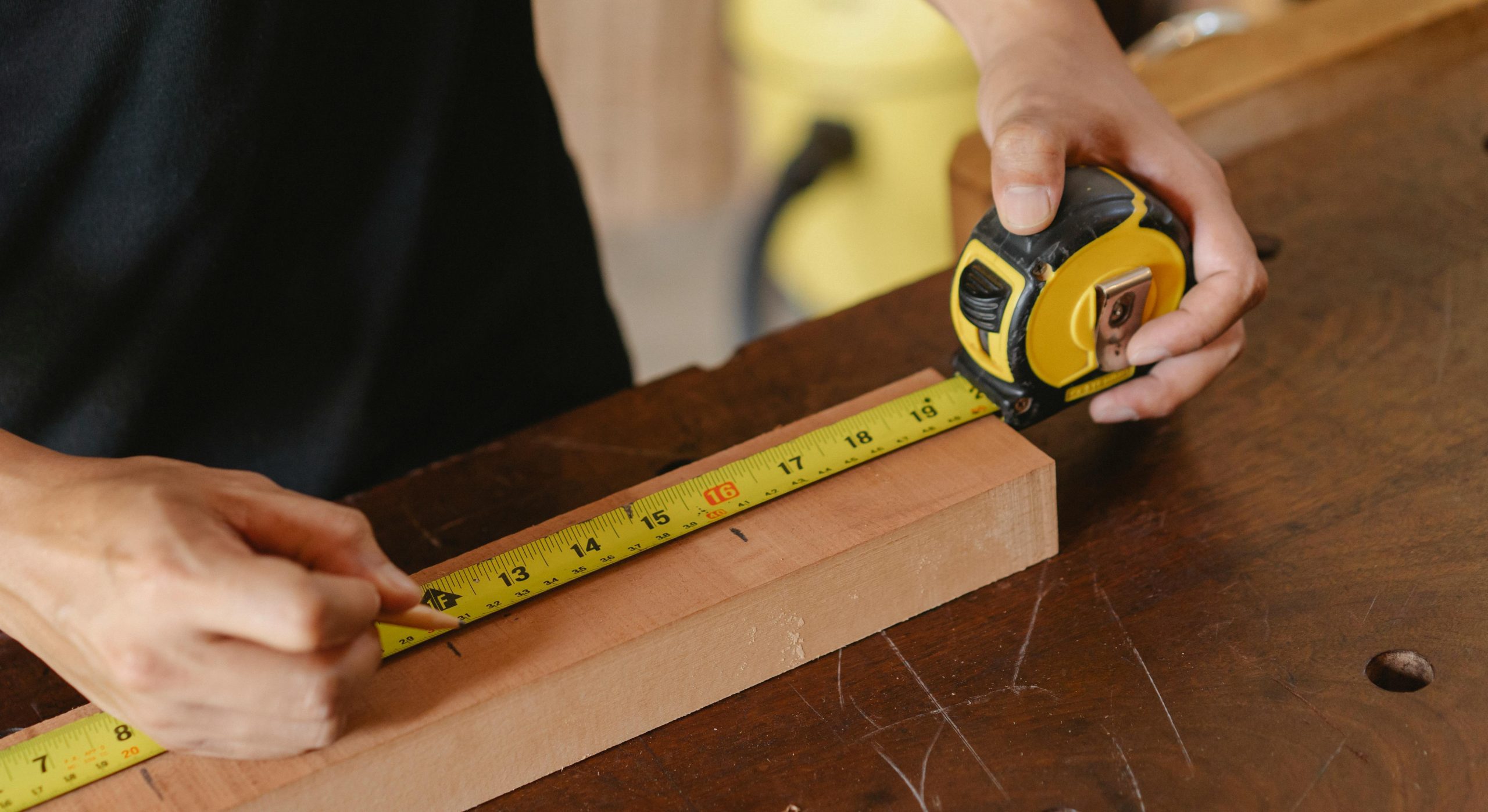
A sturdy tape measure (at least 5m).
-
A spirit level or laser level for accuracy.
-
A straight edge or string line to establish the pitch line.
-
A pencil and notepad for recording measurements.
-
Optional: a digital angle finder for unusual staircases.
Step 1: Identify the Pitch Line
The pitch line is the invisible line running along the nosings (front edges) of the stair treads. It forms the basis for most stair railing measurements.
-
Place a straight edge or stretch a string from the nose of the bottom tread to the nose of the top tread.
-
This diagonal line is your pitch line.
-
All handrail height measurements on the flight of stairs are taken vertically from this line.
Step 2: Measure Handrail Height on the Flight
Now you can establish the correct handrail height.
-
Place your tape measure vertically from the pitch line at several points along the staircase.
-
Mark between 900mm and 1000mm – this is your acceptable range.
-
Choose a consistent height within this range (e.g. 950mm) for a balanced look and feel.
-
Record the measurement to use when ordering or cutting your railing.
Step 3: Measure Handrail Height on Landings
At the top or bottom of your stairs, where the floor levels off, the rules are slightly different:
-
Measure vertically from the finished floor surface.
-
Mark a point between 900mm and 1100mm – this is the correct landing height.
-
Again, consistency matters, so match the landing height as closely as possible to the height of the stair flight handrail.
Step 4: Measure the Length of the Stair Railing
The length of the railing depends on how many treads your staircase has.
-
Count the total number of risers (the vertical parts of each step).
-
Multiply the going (horizontal depth) of each tread by the number of treads to estimate the length.
-
Alternatively, measure directly along the pitch line from the bottom to the top nosing.
-
Add extra length if your railing design requires returns or overhangs.
Step 5: Check Stair Width and Number of Rails Needed
-
If your staircase is under 1000mm wide, you only need a railing on one side.
-
If it’s over 1000mm wide, you must fit railings on both sides.
-
Measure the clear width of the stair between the walls or stringers to confirm.
Step 6: Measure for Balusters (Spindles)
Spacing is critical for safety and compliance:
-
Measure the total length of the handrail.
-
Divide by the width of one baluster plus spacing (usually around 100mm).
-
Ensure no gap exceeds 99mm – a test is that a 100mm sphere should not be able to pass through.
This will tell you how many balusters you need and where to place them.
Step 7: Consider Wall-Mounted Handrails
If your handrail is fixed directly to a wall rather than on newel posts:
-
Measure the stair length along the pitch line.
-
Note fixing points – the handrail should be continuous but leave adequate clearance from walls (usually at least 50mm).
-
Record exact bracket positions for correct spacing.
Step 8: Double-Check All Measurements
Before you place an order or start cutting materials:
-
Re-measure every dimension to confirm accuracy.
-
Compare with UK regulation requirements.
-
Record everything clearly so installers or suppliers have no doubts.
A common mistake is measuring from the wrong point (e.g. floor level instead of pitch line) – always double-check before committing.
Common Pitfalls to Avoid
-
Incorrect reference points – always measure from the pitch line or finished floor.
-
Inconsistent heights – ensure the handrail is level and continuous.
-
Overlooking landings – don’t forget regulations differ slightly here.
-
Not accounting for returns – order enough material to cover ends and bends.
-
Ignoring clearance – leave enough room between rail and wall for hands to grip comfortably.
Should You Measure Yourself or Hire a Professional?
If you’re confident with a tape measure and have a straight staircase, measuring yourself is relatively straightforward. However, for:
-
Spiral or curved staircases,
-
Properties with non-standard dimensions,
-
Projects requiring bespoke metalwork or timber,
…it’s often best to hire a surveyor or railing specialist. They’ll ensure exact compliance with regulations and minimise costly mistakes.
Final Checklist – How Do You Measure for a Stair Railing?
When measuring for your stair railing, make sure you have:
-
Correctly identified the pitch line.
-
Measured handrail height on both flights and landings.
-
Confirmed stair width to determine if you need one or two rails.
-
Calculated the length of the railing accurately.
-
Checked baluster spacing complies with the 100mm rule.
-
Allowed clearance from walls for grip comfort.
Conclusion – How Do You Measure for a Stair Railing?
Measuring for a stair railing in the UK isn’t complicated, but it does require care and precision. By following the steps above – and always cross-checking against UK Building Regulations (Approved Document K) – you can ensure your new railing is both safe and stylish.
If in doubt, consult a professional installer or surveyor. Correct measurement at the planning stage saves time, money, and frustration later. A properly fitted railing not only enhances safety but also adds elegance and value to your property.
Contact us today to disucss your staircase requirements or use our online staircase builder tool.