What Is the Code for Stairs to a Loft?
If you are planning a loft conversion, one of the most important questions you will face is: what is the code for stairs to a loft?
In the UK, loft stairs must comply with Building Regulations Approved Document K (Part K), which governs the safe design of staircases, ladders, and guarding. These rules ensure that stairs are safe, comfortable to use, and suitable for everyday access.
However, loft conversions often come with tight spaces and structural limitations. Because of this, Part K allows certain allowances and flexibility for loft staircases, provided safety is still maintained.
This guide explains the key regulations, measurements, and design principles involved in building compliant loft stairs.
Why Loft Stairs Must Meet Building Regulations
When a loft is converted into a habitable room, the staircase becomes the primary access route to a living space. This means it must be designed to meet safety standards just like any other staircase in a home.
The regulations exist to ensure:
-
Safe and comfortable stair use
-
Adequate headroom when walking upstairs
-
Consistent step heights to prevent trips
-
Proper handrails and guarding
-
A staircase pitch that is safe to climb
Failure to meet these regulations can result in building control rejecting the conversion, requiring costly alterations before approval.
The Key Regulation: Approved Document Part K
In the UK, staircase design is controlled by Approved Document K – Protection from Falling, Collision and Impact.
Part K specifies the maximum pitch, minimum headroom, rise and going dimensions, and guarding requirements for domestic staircases.
For loft conversions, there are two main scenarios:
-
Standard stairs where space allows
-
Alternating tread or space saver stairs where space is limited
Each option has slightly different rules.
Maximum Stair Pitch for Loft Stairs
One of the most important requirements is the maximum stair pitch (angle).
For standard stairs serving a loft conversion:
Maximum pitch: 42°
This ensures the staircase remains comfortable and safe to climb.
Steeper stairs can become dangerous, particularly when descending, which is why the pitch is strictly controlled.
Where space is extremely tight, alternating tread stairs (space saver stairs) may be permitted, which can have a steeper pitch.
However, these are only allowed when:
-
The loft contains one habitable room
-
There is no practical space for a conventional staircase
Minimum Headroom for Loft Stairs
Headroom is another critical factor in loft staircase design.
For standard stairs, the regulations require:
Minimum headroom: 2.0 metres
However, because lofts are often constrained by sloping roofs, Part K allows reduced headroom in certain circumstances.
For loft conversions:
Minimum headroom can be reduced to 1.9 metres at the centre of the staircase and 1.8 metres at the edges.
This relaxation makes it possible to fit a staircase under a pitched roof while still maintaining safe access.
Designers often position the staircase so the highest part of the roof aligns with the walking line.
Rise and Going Requirements
The dimensions of each step are known as the rise and the going.
These measurements must stay within specific limits to ensure the staircase is comfortable and safe.
Typical limits for domestic stairs are:
Maximum rise: 220mm
Minimum going: 220mm
The rise refers to the vertical height of each step, while the going refers to the depth of the tread.
Steps must also be consistent throughout the staircase. Even small variations can increase the risk of trips or falls.
A commonly used relationship between rise and going is:
2R + G = between 550mm and 700mm
This formula helps ensure the stair feels natural to walk on.
Stair Width Requirements
Unlike some other elements of building regulations, Part K does not specify a strict minimum width for domestic stairs.
However, in practice:
-
Most loft staircases are between 700mm and 900mm wide
-
Narrower stairs may feel uncomfortable or difficult to move furniture through
-
Wider stairs improve usability and safety
The final width is usually determined by the available structural space within the house.
Handrails and Balustrades
To prevent falls, loft stairs must include appropriate guarding and handrails.
Key requirements include:
-
A handrail on at least one side of the staircase
-
Balustrades where there is a drop
-
Gaps in balustrades must not allow a 100mm sphere to pass through
This 100mm rule is designed to prevent children from slipping through the balusters.
Handrails should also be positioned at a comfortable height, typically between:
900mm and 1000mm above the pitch line.
Loft Stair Landings
Every staircase must have proper landings at the top and bottom.
The landing must:
-
Be at least as wide as the staircase
-
Provide safe access to the loft room
-
Allow doors to open safely without obstructing the stairs
Where a door opens onto the staircase, additional clearance may be required.
This ensures users do not step directly onto the first tread when opening the door.
When Space Saver Stairs Are Allowed
In some loft conversions, space constraints make it impossible to install a conventional staircase.
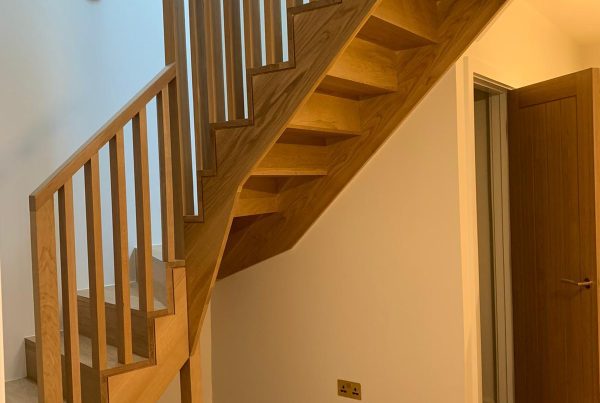
In these cases, alternating tread stairs (often called space saver stairs) may be permitted.
These stairs:
-
Have alternating left and right treads
-
Allow steeper angles
-
Take up significantly less floor space
However, they are only allowed when:
-
Serving a single loft room
-
There is no other viable stair solution
-
They are not the only staircase in the home
Because they require a different walking pattern, they are not suitable for all situations.
The Importance of Correct Stair Design
Designing a loft staircase is rarely straightforward. Many factors must be considered simultaneously, including:
-
Floor-to-floor height
-
Roof slope and headroom
-
Structural joists
-
Stair pitch and geometry
-
Landing positions
A staircase that looks simple can actually involve complex geometric design to meet building regulations while fitting into a tight space.
This is why loft stairs are typically designed by specialist staircase manufacturers or experienced architectural designers.
What Is the Code for Stairs to a Loft? Final Thoughts
The building regulations for loft stairs are designed to balance safety, comfort, and practicality.
In summary, the code for stairs to a loft key requirements include:
-
Maximum stair pitch of 42°
-
Minimum headroom of 2.0m (with some loft allowances)
-
Maximum rise of 220mm
-
Minimum going of 220mm
-
Proper handrails and guarding
-
Safe landings at the top and bottom
While there is flexibility in certain situations, especially with loft conversions, every staircase must still meet the fundamental safety principles set out in Approved Document K.
If you are planning a loft conversion, it is essential to ensure your staircase is carefully designed from the outset to meet both the available space and the building regulations.
Contact us today to disucss your staircase requirements or use our online staircase builder tool.